
GLOUDONE | INDUSTRY BUSINESS CASES
Automobile Workshop Management
From Vehicle Reception to Workshop Profitability.

Explore how GloudOne connects vehicle inspections, service estimates, job cards, technician assignments, spare parts, accident repairs, insurance jobs, customer billing and vehicle delivery. Discover practical workflows that bring workshop operations, financial controls and management intelligence together.
Designed for independent automobile workshops, multi-branch service centres and fleet maintenance operations.
Explore Our Workshop Business Cases
Six practical business situations revealing where automobile workshops lose time, revenue and profitability — and how better processes, controls and management intelligence can address them.
01. Workshop Operations & Revenue Control
From vehicle reception and repair approvals to technician productivity, spare parts consumption and job profitability.
02. Financial Control, Customer Experience & Management Intelligence
From accident repair settlements and vehicle delivery to customer retention, workshop performance and management decisions.
BUSINESS CASE 01 | AUTOMOBILE WORKSHOP MANAGEMENT
Why Do Workshops Lose Revenue Between Vehicle Reception and Job Approval?
A vehicle enters the workshop for a routine service. During inspection, the technician identifies additional repairs. Some work is discussed verbally, estimates are revised, customer approvals are delayed, and the final invoice does not always reflect everything performed. This is where an otherwise busy workshop can lose revenue without anyone noticing.

A Typical Workshop Situation
A customer brings a vehicle for periodic maintenance. The service advisor records the customer’s complaints and prepares an initial estimate. During inspection, the technician discovers worn brake pads and a leaking component that require additional attention.
The service advisor contacts the customer for approval. Meanwhile, the vehicle occupies a service bay. Another technician may begin work based on a verbal instruction, while the revised estimate remains unconfirmed. At billing time, the workshop must reconstruct what was originally requested, what was approved and what was actually completed.
Where the Business Loses Control
- Customer complaints and inspection findings are not recorded consistently.
- Additional repairs are identified after the original estimate.
- Verbal approvals are difficult to verify later.
- Technicians may perform work before formal authorisation.
- Waiting for customer approval can delay workshop execution.
- Completed work and consumed materials may not be fully reflected in the invoice.
- Disputes arise when customers question additional charges.
How the Business Should Operate
Every vehicle should move through a controlled reception, inspection, estimation and approval process. The service advisor should have a complete record of customer instructions, inspection findings, proposed repairs, estimated costs and approval status.
- Identify the customer and vehicle using registration details and service history.
- Record customer complaints, vehicle condition, mileage and inspection observations.
- Capture photographs of visible damage and relevant inspection findings.
- Prepare an estimate covering labour, parts and applicable charges.
- Obtain and record customer approval before authorised work begins.
- Create supplementary estimates when additional repairs are identified.
- Keep approved, rejected and pending work clearly separated.
- Link approved repair activities to the job card and subsequent billing.
How GloudOne Enables This Process
GloudOne connects vehicle reception, digital inspection, estimate preparation, customer approvals and job card management through one workflow. Service advisors and workshop supervisors can review the status of each repair request, while authorised work, labour requirements and parts consumption remain connected to the relevant job. Changes to the approved scope can follow a documented approval process rather than depending on verbal instructions.
What Management Can See
Management can identify vehicles awaiting estimates, customer approvals and supplementary repair decisions. Reports can highlight approval delays, differences between estimated and billed values, rejected repair recommendations and jobs where work has progressed without the required authorisation. These insights help management address potential revenue leakage and workshop delays before they become recurring problems.
Expected Business Outcomes
Better estimate accuracy, stronger customer approval controls, fewer billing disputes, reduced unbilled repair work, clearer job accountability and improved coordination between service advisors and technicians. The workshop gains a more dependable connection between the work requested, the work approved, the work performed and the amount billed.
BUSINESS CASE 02 | AUTOMOBILE WORKSHOP MANAGEMENT
Why Is the Workshop Full but Technician Productivity Still Low?
A workshop may have vehicles in every service bay and technicians working throughout the day, yet complete fewer jobs than expected. The problem is not always a shortage of technicians or workshop space. Delayed parts, pending approvals, ineffective job allocation, interruptions and repeated repairs can consume valuable working hours without generating corresponding revenue.

A Typical Workshop Situation
Consider a workshop operating with eight service bays and twelve technicians. At the beginning of the day, several vehicles are already awaiting repairs. New vehicles continue to arrive, and the workshop supervisor assigns jobs based on immediate availability rather than a consolidated plan.
One technician begins dismantling a vehicle before discovering that a required spare part is unavailable. Another job remains on hold for customer approval. A third vehicle occupies a service bay even though no active work is taking place. Meanwhile, a technician is repeatedly moved between jobs, making it difficult to establish how much productive time was actually spent.
By the end of the day, the workshop has been busy, but several vehicles remain unfinished. The supervisor knows which jobs are pending but may not have reliable information explaining where the working hours were lost.
Where the Business Loses Control
- Jobs are assigned without checking technician skills, workload or available capacity.
- Vehicles occupy service bays while waiting for parts or customer approvals.
- Estimated labour hours are not consistently compared with actual working hours.
- Technicians switch between jobs without accurate time recording.
- Urgent jobs disrupt previously scheduled work.
- Repeated repairs and rework consume productive capacity without corresponding revenue.
- Management cannot easily distinguish productive time from waiting time and avoidable delays.
How the Business Should Operate
Workshop planning should begin with visibility of approved jobs, required skills, estimated labour hours, parts availability and service bay capacity. Each job should have a planned execution sequence, responsible technicians and a target completion time.
- Review pending and newly approved jobs before daily work allocation.
- Check required spare parts and approvals before assigning service bays wherever practical.
- Allocate technicians according to skills, availability and estimated workload.
- Record job start, pause, restart and completion activities.
- Capture reasons for delays, including parts shortages, approval waiting and technical difficulties.
- Monitor planned labour hours against actual time consumed.
- Introduce supervisor review for jobs exceeding estimated time or target completion.
- Record rework separately to identify recurring quality problems.
How GloudOne Enables This Process
GloudOne brings job cards, technician allocation, workshop activity updates, spare parts requirements and approval status into a connected operational workflow. Workshop supervisors can review jobs awaiting allocation, work in progress, delayed repairs and completed activities. Planned and actual labour information can be used to analyse technician performance, while exception reporting helps identify jobs requiring immediate management attention.
What Management Can See
Management can monitor active and idle service bays, technician assignments, estimated versus actual labour hours, jobs waiting for parts or approvals, delayed vehicle deliveries and repeat repairs. Productivity analysis can distinguish hours available, hours spent on jobs and labour hours billed, helping management identify the causes of low labour recovery rather than relying only on the number of vehicles serviced.
Expected Business Outcomes
Improved job scheduling, better technician utilisation, reduced waiting time, faster vehicle turnaround, stronger control over rework and improved labour recovery. The workshop can increase productive output from its existing technicians and service bays before considering additional manpower or infrastructure investment.
BUSINESS CASE 03 | AUTOMOBILE WORKSHOP MANAGEMENT
Where Does the Profit Disappear in Spare Parts and Job Costing?
A workshop can complete a repair, issue an invoice and collect payment while still losing part of its expected profit. Spare parts may be issued without proper job references, purchased urgently at higher prices, replaced during repairs without recording additional consumption, or returned without updating the job cost. When parts, labour and purchasing information are disconnected, management may see sales revenue but not the true profitability of individual jobs.

A Typical Workshop Situation
A customer approves a repair estimate covering labour and several replacement parts. The technician begins work using materials issued from the workshop store. During dismantling, an additional component is found damaged, and the technician requests an urgent purchase from a nearby supplier.
The supplier delivers the component directly to the workshop floor. The original replacement part is later found unsuitable and returned to the store, but the return is not immediately recorded. Small consumables are also used during the repair without being allocated to the job.
When the vehicle is ready, the service advisor prepares the invoice using the original estimate and the additional items that were communicated. However, the actual parts consumption and procurement costs may not fully match the invoice. The workshop completes the job without knowing whether the expected margin was achieved.
Where the Business Loses Control
- Spare parts are issued without consistently identifying the consuming job card.
- Urgent purchases are made without comparing available stock or approved supplier prices.
- Parts delivered directly to technicians may bypass normal receipt and issue procedures.
- Unused or incorrectly issued parts are not returned and accounted for promptly.
- Consumables and additional components are used without being included in job costing.
- Actual labour hours and parts costs are not compared with the approved estimate.
- Workshop management cannot identify which repair categories, jobs or branches generate weak margins.
How the Business Should Operate
Every spare part requested, reserved, purchased, issued, consumed or returned should remain connected to the relevant job card. The workshop should know the estimated cost before execution and the actual cost before final billing and job closure.
- Prepare job-wise spare parts requirements from the approved repair estimate.
- Check stock availability, compatible alternatives and existing reservations before procurement.
- Reserve and issue available parts against the authorised job card.
- Route unavailable parts through a controlled purchase request and supplier procurement process.
- Record urgent purchases and direct-to-job deliveries with the correct cost allocation.
- Track additional parts requirements and obtain customer approval where required.
- Record unused parts, replacement items and returns to stock.
- Compare estimated and actual parts costs, labour costs and billing values before job closure.
How GloudOne Enables This Process
GloudOne connects workshop job cards with spare parts inventory, purchasing, stock movements, supplier transactions and financial accounting. Parts requirements can originate from approved repair activities, while stock issues, purchase receipts and returns remain traceable to the relevant job. Actual material costs and labour information can be consolidated to support job-level profitability analysis, giving service advisors and management a clearer understanding of the financial impact of each repair.
What Management Can See
Management can review estimated versus actual parts costs, emergency purchases, unbilled material consumption, parts returns, slow-moving inventory and job-level gross margins. Reports can highlight jobs where actual costs exceed approved estimates, suppliers with higher procurement costs and repair categories generating lower-than-expected profitability. This enables corrective action at the job, store, purchasing and branch levels.
Expected Business Outcomes
Reduced unrecorded parts consumption, better control over urgent procurement, improved stock accuracy, fewer unbilled materials and more dependable job costing. Workshop management gains visibility into actual repair margins and can address profit leakage before it becomes a recurring financial problem.
BUSINESS CASE 04 | AUTOMOBILE WORKSHOP MANAGEMENT
Why Do Accident Repair Jobs Become Financially Complicated?
An accident repair involves more than restoring a damaged vehicle. The workshop must coordinate inspections, estimates, insurer approvals, additional repair requirements, spare parts, customer contributions and financial settlements. When these activities are handled independently, the workshop may complete the repairs while significant amounts remain unapproved, disputed or outstanding.

A Typical Workshop Situation
A customer brings an accident-damaged vehicle to the workshop. The service advisor records the damage, photographs the affected areas and prepares an initial repair estimate. The estimate is submitted to the insurance company for assessment and approval.
The insurer approves only part of the estimated repair value. Once dismantling begins, the workshop discovers additional damage that was not visible during the original inspection. A supplementary estimate is prepared, but approval takes several days. Meanwhile, the vehicle occupies workshop space and some required parts have already been ordered.
After completing the repairs, the workshop must determine which charges are payable by the insurer, which are payable by the customer and which amounts are not recoverable. The insurer may subsequently deduct certain charges during settlement. Without clear financial tracking, the workshop may struggle to identify the outstanding balance and the actual profitability of the repair.
Where the Business Loses Control
- Initial repair estimates and insurer-approved amounts are not clearly distinguished.
- Supplementary repair requirements are discovered after work begins.
- Additional repairs may proceed without documented approval.
- Customer excess, deductibles and non-covered repairs are not communicated consistently.
- Parts are ordered before the required repair scope is fully authorised.
- Claim submissions, supporting documents and insurer responses are tracked separately.
- Insurer deductions and partial settlements are difficult to reconcile.
- Completed repair jobs remain financially open without clear ownership of outstanding amounts.
How the Business Should Operate
Every accident repair should have a complete financial and operational record connecting the damage assessment, estimates, approvals, repair execution, invoicing, claims and settlement. The workshop should distinguish approved work from pending work and identify the responsible payer for each charge.
- Register the accident repair job with vehicle, customer, insurer and claim details.
- Record inspection findings, damage photographs and supporting documents.
- Prepare the initial repair estimate with labour, spare parts and other charges.
- Track insurer assessment, approved amounts, exclusions and approval conditions.
- Manage supplementary estimates and approvals for hidden or additional damage.
- Separate insurer-payable, customer-payable and non-recoverable amounts.
- Control spare parts procurement and repair execution against the approved scope.
- Prepare invoices and claim documentation according to the applicable arrangements.
- Record partial payments, deductions, disputes and final settlement adjustments.
- Close the job financially only after outstanding balances and authorised adjustments are accounted for.
How GloudOne Enables This Process
GloudOne provides a connected approach to accident repair management by bringing job cards, damage assessments, estimates, approval workflows, spare parts, repair costs, billing and receivables into one operational and financial process. Insurer and customer responsibilities can be identified against the relevant repair activities, while supplementary estimates, claim documentation and settlement transactions can be tracked against the job.
What Management Can See
Management can monitor accident repair jobs awaiting insurer approval, supplementary estimates pending assessment, vehicles delayed by claim decisions, insurer-wise outstanding receivables and settlement deductions. Financial analysis can compare original estimates, approved repair values, actual costs, billed amounts and collected amounts to identify unrecovered expenses and repair profitability.
Expected Business Outcomes
Better control over insurer approvals, fewer unauthorised repair expenses, clearer customer payment responsibilities, improved claim documentation, faster identification of outstanding settlements and more reliable accident repair profitability. The workshop gains visibility not only into whether a vehicle has been repaired, but also whether the corresponding revenue has been approved, billed and recovered.
BUSINESS CASE 05 | AUTOMOBILE WORKSHOP MANAGEMENT
Why Do Completed Jobs Still Result in Lost Revenue and Unhappy Customers?
A vehicle may be mechanically ready for delivery, but the workshop’s responsibility does not end with the repair. Final quality inspection, additional work verification, invoicing, payment clearance and customer handover must be coordinated. When these activities are disconnected, completed jobs can lead to unbilled charges, delayed collections, repeat complaints and dissatisfied customers.

A Typical Workshop Situation
A customer leaves a vehicle for a major service and several repairs. During execution, the technician replaces an additional component after receiving approval from the service advisor. The work is completed, and the technician informs the supervisor that the vehicle is ready.
The customer arrives to collect the vehicle. However, the final invoice has been prepared using the original estimate, and the additional component has not been included. The quality inspection checklist is incomplete, and the service advisor is unable to confirm whether all customer complaints were resolved.
To avoid keeping the customer waiting, the vehicle is released. A few days later, the customer reports that one of the original problems remains unresolved. The workshop must arrange another inspection, allocate technician time and possibly perform additional work without recovering the full cost.
Where the Business Loses Control
- Technician completion is treated as final job closure without independent quality verification.
- Customer complaints recorded during reception are not checked individually before delivery.
- Additional approved repairs and spare parts may be omitted from the final invoice.
- Discounts and adjustments are applied without appropriate authorisation.
- Vehicles are released without confirming payment or approved credit arrangements.
- Customer handover details, mileage and vehicle condition are not consistently documented.
- Repeat complaints and rework are not linked to the original repair job.
- Service reminders and customer follow-up activities are missed.
How the Business Should Operate
Every completed repair should pass through a structured quality, billing and delivery process. The workshop should verify that the approved work has been completed, customer complaints have been addressed, all chargeable activities are included in billing and the required financial clearance is available before vehicle handover.
- Record technician completion against individual job card activities.
- Perform final quality inspection and road testing where applicable.
- Verify the original customer complaints and approved additional repair activities.
- Compare completed work, parts consumption and labour charges with the final invoice.
- Review discounts, warranty adjustments and other billing exceptions.
- Confirm payment collection or authorised credit before vehicle release.
- Record vehicle delivery details, mileage, condition and customer acknowledgement.
- Update the vehicle’s service and repair history.
- Schedule maintenance reminders and appropriate customer follow-up.
- Register repeat complaints and link rework to the original job for quality analysis.
How GloudOne Enables This Process
GloudOne connects workshop job completion, quality inspection, billing, collections and vehicle delivery through a coordinated workflow. Completed activities and consumed materials can be reviewed before invoicing, while payment or credit approval can form part of the vehicle release process. Customer and vehicle service histories provide continuity for future visits, and repeat complaints can be tracked against previous repairs to support service quality improvements.
What Management Can See
Management can monitor completed jobs awaiting quality inspection, vehicles ready for delivery, invoices pending preparation, unbilled parts or labour, vehicles awaiting payment clearance and delayed handovers. Customer service analysis can identify repeat complaints, rework frequency, service turnaround times and customers due for their next scheduled maintenance. These insights connect workshop performance with both financial discipline and customer experience.
Expected Business Outcomes
Reduced unbilled work, stronger payment collection controls, fewer premature vehicle releases, improved repair quality, better customer communication and reduced avoidable rework. A dependable delivery and follow-up process can also support repeat business, customer retention and a stronger workshop reputation.
BUSINESS CASE 06 | AUTOMOBILE WORKSHOP MANAGEMENT
Why Can Workshop Revenue Increase While Profitability Declines?
A workshop may service more vehicles and generate higher monthly revenue without achieving better profitability. Additional technicians, longer working hours, urgent spare parts purchases, repeated repairs, discounts and underutilised service bays can gradually increase operating costs. When management reviews only sales and total expenses, the reasons for declining margins often remain hidden.
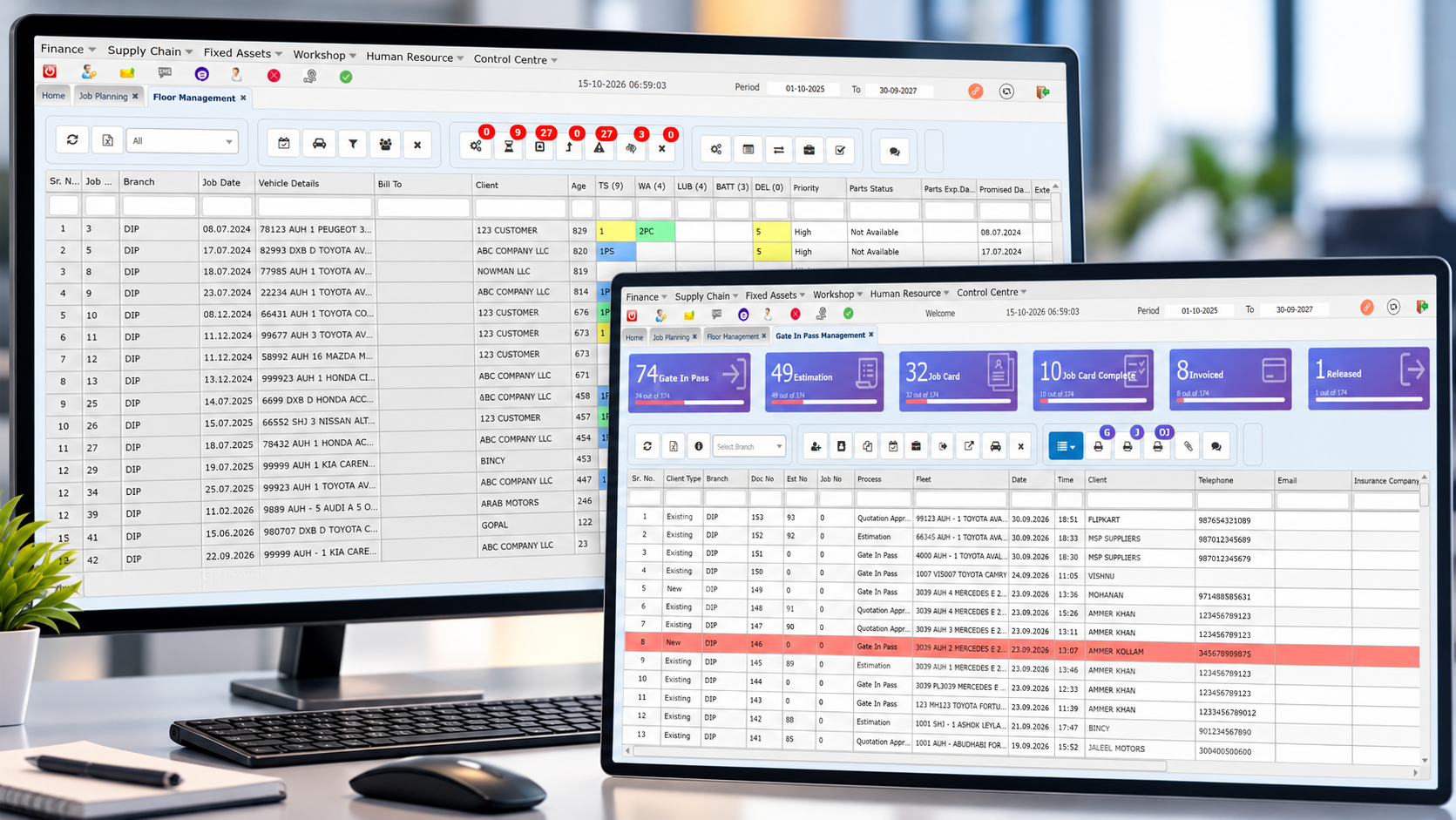
A Typical Workshop Situation
Consider a multi-branch automobile workshop business. Monthly sales have increased, and management believes the business is performing well. However, the finance department reports that operating profit has declined despite the additional revenue.
One branch completes a large number of jobs but frequently offers discounts to retain customers. Another branch has highly skilled technicians but loses productive hours because of poor scheduling and parts shortages. Accident repair jobs generate substantial invoice values, but some insurance settlements remain outstanding and certain repair costs exceed the approved estimates.
At the same time, repeat repairs consume technician hours without generating new revenue. Management knows the overall financial result but cannot easily connect declining profitability to specific jobs, technicians, repair categories or branches.
Where the Business Loses Control
- Revenue is monitored without consistently analysing job-level gross profitability.
- Actual labour hours exceed estimated or billed labour hours.
- Service bays remain occupied by vehicles awaiting parts, approvals or customer collection.
- Rework and repeat complaints consume resources without additional revenue.
- Discounts and price adjustments reduce margins without sufficient management visibility.
- Urgent procurement and uncontrolled parts consumption increase repair costs.
- Accident repair claims and corporate customer balances remain outstanding.
- Branch performance is compared by sales rather than profitability, capacity and operating efficiency.
- Workshop overheads are not adequately considered when evaluating overall profitability.
How the Business Should Operate
Workshop management should connect operational performance with financial results. Every completed job should contribute reliable information about revenue, spare parts costs, labour consumption, discounts and gross margin. These results should be analysed alongside technician capacity, service bay utilisation, work-in-progress, rework and branch operating expenses.
- Measure revenue and gross margin by job, service category, customer and branch.
- Compare estimated, actual and billed labour hours to identify labour recovery gaps.
- Monitor technician productivity and available workshop capacity.
- Analyse service bay occupancy and reasons for non-productive waiting time.
- Identify jobs where actual parts and labour costs exceed estimated values.
- Track discounts, warranty work, rework and non-chargeable activities.
- Monitor outstanding customer balances, insurance claims and delayed collections.
- Compare branch profitability after considering relevant operating expenses.
- Review exceptions regularly and assign corrective actions to responsible managers.
How GloudOne Enables This Process
GloudOne connects workshop operations with inventory, procurement, billing, collections and financial accounting to support management-level analysis. Job card activities, labour consumption, spare parts costs, customer invoices and financial transactions can contribute to a consolidated view of workshop performance. Through management dashboards and business intelligence, decision-makers can analyse profitability by job, service category and branch while identifying operational exceptions that require corrective action.
What Management Can See
Management can examine workshop performance through connected operational and financial indicators rather than relying only on monthly sales figures.
- Job Profitability: Revenue, direct costs and gross margin by individual job.
- Labour Recovery: Available, productive and billed labour hours.
- Workshop Capacity: Service bay utilisation, idle time and delayed jobs.
- Parts Profitability: Material consumption, procurement costs and parts margins.
- Quality Costs: Rework, repeat complaints and warranty-related expenses.
- Financial Control: Discounts, receivables, pending insurance settlements and collection ageing.
- Branch Performance: Revenue, gross margin, operating expenses and profitability comparisons.
From Information to Management Action
The real value of management intelligence is not simply identifying that profitability has declined. It is understanding why. A branch with low labour recovery may need better scheduling rather than additional technicians. A repair category with declining margins may require revised estimates or tighter spare parts controls. A high-revenue accident repair division may need stronger claim follow-up and settlement management.
By connecting the underlying business transactions with management reporting, workshop leaders can identify the source of performance problems, assign corrective responsibilities and measure whether the actions taken are improving results.
Expected Business Outcomes
Greater visibility into workshop profitability, stronger labour and capacity utilisation, reduced avoidable repair costs, improved pricing discipline and better control over outstanding collections. Management can make informed decisions about staffing, workshop expansion, service pricing, procurement and branch performance based on operational and financial evidence.
GLOUDONE | AUTOMOBILE WORKSHOP MANAGEMENT
See How GloudOne Can Work for Your Workshop Business
Connect vehicle reception, job cards, workshop operations,
spare parts, billing, collections and management intelligence
through one unified business platform.
spare parts, billing, collections and management intelligence
through one unified business platform.