
GLOUDONE | MANUFACTURING
From Customer Demand to Production.
From Production to Profitability.
Manufacturing success depends on more than production. It requires connected engineering, material planning, procurement, shop-floor operations, quality, delivery and financial control. GloudOne brings the entire manufacturing journey together on one intelligent business platform.

01. Discrete Manufacturing
Office furniture, fixtures and kitchen cabinets. From customer enquiry and engineering approval to production, site installation and profitability.
02. Batch / Process Manufacturing
Lubricating oils and greases. Explore how GloudOne connects product formulation, batch planning, raw materials, blending, quality control, filling, packaging and production profitability.
03. Line / Repetitive Manufacturing
Paint tins, metal containers and utensils. Explore how GloudOne connects production scheduling, raw material availability, tooling, machine operations, quality, finished goods and line-wise profitability.
BUSINESS CASE 01 | DISCRETE MANUFACTURING
Every Custom Order Starts With a Drawing. Profit Starts With Control.
In office furniture and kitchen cabinet manufacturing, every customer order may involve different measurements, designs, materials, finishes and installation requirements. GloudOne connects customer enquiries, site measurements, shop drawings, engineering approvals, material planning and commercial confirmation so that production begins with clear, approved requirements.

The Business Challenge
A corporate customer requests workstations, storage cabinets and a customised pantry kitchen. The sales team prepares an estimate, the design team develops drawings and the engineering team determines how the products will be manufactured. However, customer revisions, changing dimensions, material substitutions and approval delays can create confusion. If production begins using outdated drawings or an unapproved bill of materials, the result may be rework, excess material consumption, delivery delays and reduced margins.
How GloudOne Addresses It
GloudOne connects the commercial and engineering stages through a structured process, maintaining visibility from the initial customer requirement to the approved production specification.
- Enquiry registration: Record customer requirements, project location, product categories, quantities and expected delivery dates.
- Site survey: Capture site measurements, installation conditions, photographs and technical observations.
- Design and shop drawings: Maintain drawing submissions, revisions and supporting technical documents against the enquiry or project.
- Customer approval: Track design confirmations, requested modifications and approved drawing versions.
- Engineering validation: Review dimensions, construction methods, components, material specifications and manufacturing feasibility.
- Bill of materials: Prepare and validate the materials, fittings, accessories and components required for manufacturing.
- Cost estimation: Evaluate material requirements, labour, subcontracting, installation and expected margins.
- Commercial confirmation: Connect the approved specification and costing with the final quotation and customer order.
- Production release: Authorise manufacturing only after the required customer, engineering and commercial approvals are completed.
Management Intelligence
Management can review enquiries awaiting design, pending customer approvals, drawing revisions, engineering bottlenecks, estimated project margins and orders ready for production. This helps identify delays and commercial risks before materials are purchased or manufacturing begins.
Expected Business Outcomes
Faster enquiry-to-order conversion, improved coordination between sales and engineering, fewer drawing-related errors, stronger control over material specifications, reduced rework and improved confidence in estimated project profitability.
BUSINESS CASE 02 | DISCRETE MANUFACTURING
An Approved Design Is Only the Beginning. Can Your Factory Deliver It on Time and Within Budget?
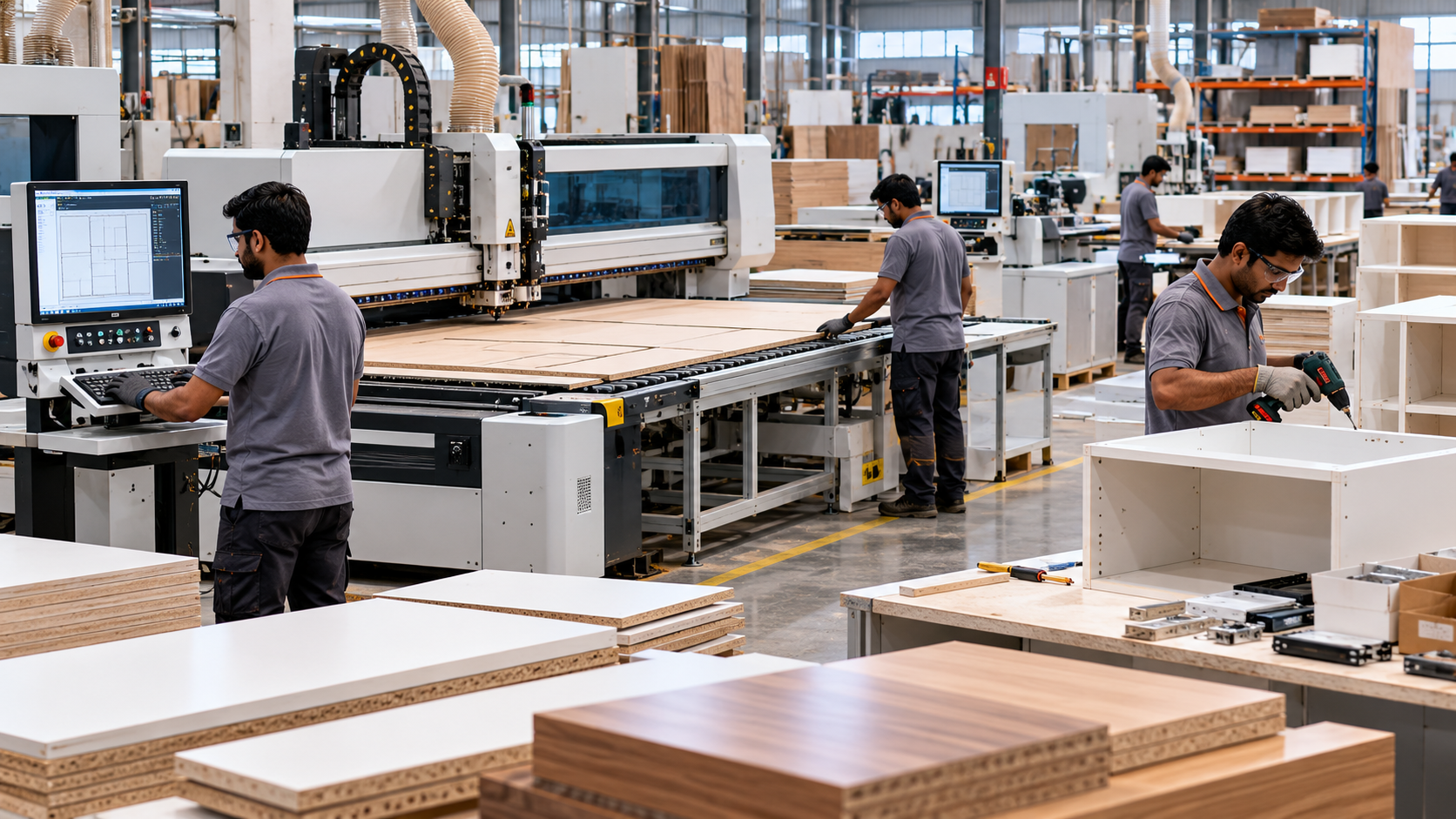
Once the customer and engineering teams approve the drawings, the real manufacturing challenge begins. Materials must be available, procurement must happen on time, production operations must be coordinated and every stage must meet quality and cost expectations. GloudOne connects the approved bill of materials with purchasing, inventory, production planning and shop-floor execution.
The Business Challenge
A manufacturer receives confirmation for customised office workstations, storage units and kitchen cabinets. Engineering has approved the drawings and BOM, but the factory must now manage different board materials, laminates, hardware, accessories and outsourced components. Cutting, edge banding, drilling, assembly and finishing must follow the correct sequence. Missing materials, machine bottlenecks, excess wastage and unrecorded rework can delay delivery and reduce project profitability.
How GloudOne Addresses It
GloudOne connects engineering-approved material requirements with procurement, warehouse operations and production-floor activities, helping teams work from one coordinated production plan.
- Approved BOM and routing: Establish the required materials, components and manufacturing operations against the confirmed customer order.
- Material requirement planning: Compare BOM requirements with available stock, reservations and outstanding purchase orders.
- Procurement coordination: Generate purchase requirements for shortages and track supplier commitments and material arrivals.
- Production order planning: Create production jobs, planned quantities, operation sequences and target completion dates.
- Cutting and material utilisation: Track board consumption, cutting requirements, offcuts and material wastage.
- Shop-floor execution: Record progress through cutting, CNC machining, edge banding, drilling, assembly and finishing.
- Subcontracted operations: Monitor outsourced activities, materials issued, expected returns and associated costs.
- Quality and rework: Capture inspection results, rejected components, corrections and additional production effort.
- Actual production costing: Compare planned materials, labour, subcontracting and other production costs with actual consumption.
Management Intelligence
Management can monitor production orders awaiting materials, procurement delays, work-in-progress, shop-floor bottlenecks, planned versus actual consumption, material wastage, rework costs and estimated completion dates. This helps identify production risks before they affect delivery commitments or project margins.
Expected Business Outcomes
Improved material availability, fewer production interruptions, better coordination between procurement and the factory, reduced wastage and rework, more reliable production schedules and stronger control over manufacturing costs.
BUSINESS CASE 03 | DISCRETE MANUFACTURING
Manufacturing Is Complete. But Is the Customer Project Really Finished?
For manufacturers of office furniture, fixtures and kitchen cabinets, completing production is not the end of the business process. Finished products must reach the correct site, installation teams must work according to approved schedules, defects must be resolved and customer acceptance must be secured. GloudOne connects factory completion with delivery, site installation, customer handover, billing and project profitability.

The Business Challenge
A furniture manufacturer completes a customer order covering office workstations, storage cabinets and pantry units. However, the customer site may not be ready, installation teams may be committed elsewhere and some components may still be awaiting finishing. Multiple deliveries, site modifications, damaged items and additional installation visits can increase costs. Without connecting these activities to the original customer order, management may see the manufacturing cost but not the actual profitability of the completed project.
How GloudOne Addresses It
GloudOne connects finished goods, delivery commitments, installation operations and financial control through a coordinated customer project workflow.
- Production completion: Confirm finished items, completed quantities, quality inspections and readiness for dispatch.
- Site readiness: Record customer site conditions, access permissions, measurements and installation prerequisites.
- Delivery scheduling: Plan dispatch dates, vehicles, loading sequences and delivery locations against the customer order.
- Installation planning: Assign installation teams, supervisors, subcontractors, tools and expected completion dates.
- Site execution: Track installation progress, completed areas, pending work and site observations.
- Additional work and variations: Capture customer-requested modifications, additional materials, approvals and associated charges.
- Snag and defect management: Register installation defects, damaged components, corrective actions and repeat visits.
- Customer handover: Maintain completion reports, customer acceptance, signed handover documents and pending obligations.
- Final billing and collections: Connect delivery milestones, approved variations, invoicing, retention where applicable and customer payments.
- Project profitability: Consolidate material, manufacturing, transport, installation, subcontracting and rectification costs against the final revenue.
Management Intelligence
Management can monitor completed production awaiting dispatch, deliveries pending installation, installation team utilisation, delayed projects, unresolved snags, unbilled variations, outstanding customer acceptance, collection status and estimated versus actual project margins. This provides visibility beyond the factory floor, helping management understand whether each customer project has been completed profitably.
Expected Business Outcomes
More reliable delivery and installation schedules, fewer repeat site visits, better coordination between factory and installation teams, faster customer handover, improved billing discipline, stronger recovery of variation costs and clearer visibility of actual project profitability.
BUSINESS CASE 04 | BATCH / PROCESS MANUFACTURING
Every Batch Begins With a Formula. Profitability Begins With Precision.
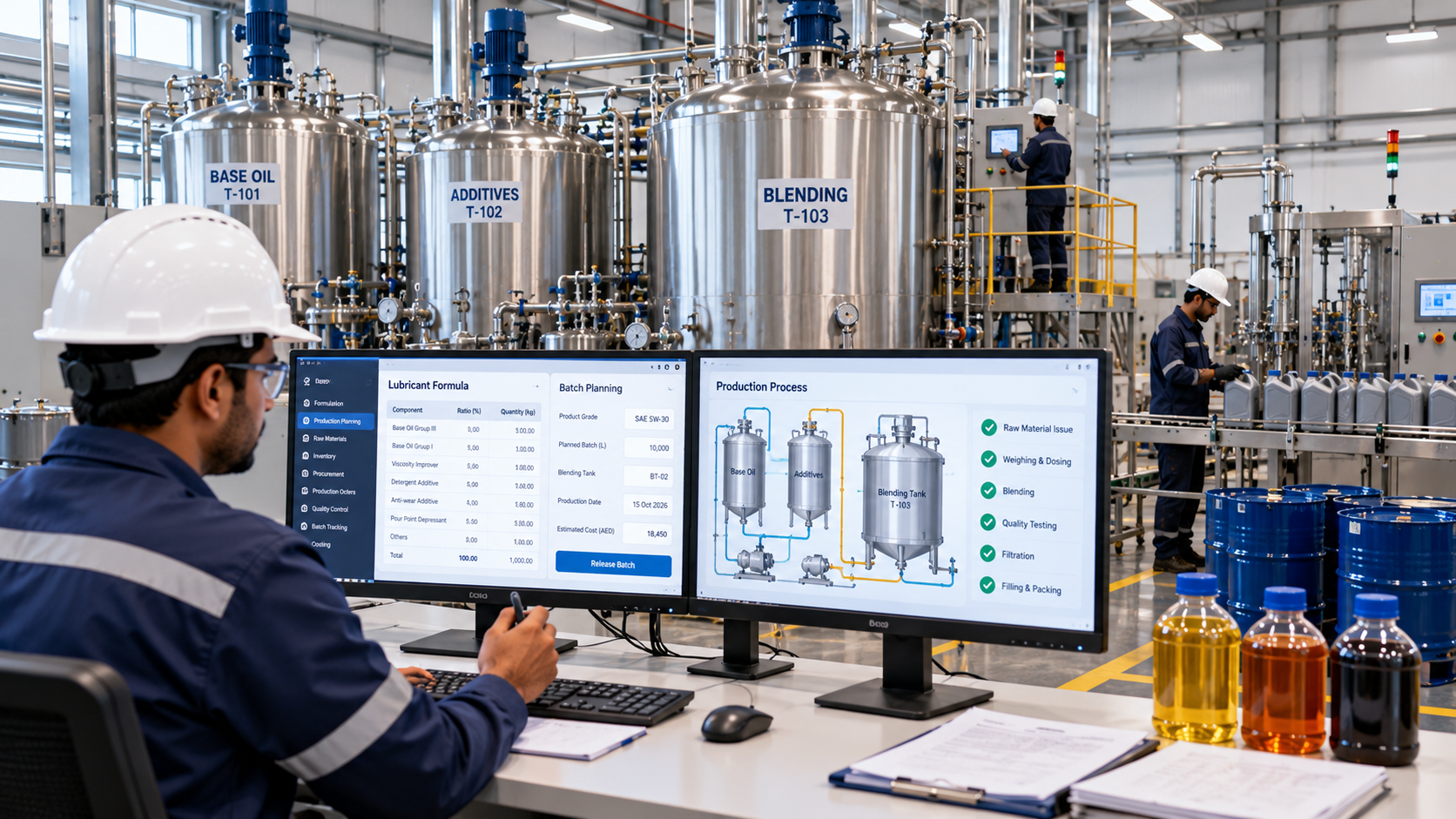
In lubricating oil and grease manufacturing, profitability depends on producing the right formulation, in the right quantity, using the right materials at the right cost. GloudOne connects customer demand, approved product formulations, inventory availability, procurement, batch planning and estimated production costs before manufacturing begins.
The Business Challenge
A lubricant manufacturer receives orders for different grades of engine oils, hydraulic oils and industrial greases. Each grade requires specific base oils, additives and approved blending ratios. Some raw materials are imported, while others are sourced locally. Production must consider minimum batch sizes, blending vessel capacity, material availability and delivery deadlines. Changes in raw material prices or formulation requirements can significantly affect production costs and margins.
How GloudOne Addresses It
GloudOne establishes a controlled planning process connecting approved formulations with demand, materials, production resources and financial expectations.
- Product and grade management: Maintain lubricant product masters, viscosity grades, specifications, units of measurement and packaging variants.
- Approved formulation management: Define base oils, additives, component ratios, formulation versions and authorised changes.
- Demand consolidation: Combine customer orders, sales forecasts and replenishment requirements to determine production quantities.
- Batch size planning: Convert production demand into planned batches based on approved formulas, vessel capacity and practical production quantities.
- Material requirement calculation: Calculate base oil and additive requirements for each planned batch, including approved allowances where applicable.
- Inventory availability: Check available quantities, reserved materials, incoming purchases and material expiry or quality status.
- Procurement planning: Identify shortages, raise purchase requirements and monitor expected material arrivals against production schedules.
- Production resource planning: Schedule blending vessels, equipment, manpower and planned production dates.
- Estimated batch costing: Calculate expected material and production costs using current cost assumptions before releasing the batch.
- Approval and batch release: Route formulation changes, production quantities and batch plans through defined authorisation workflows.
Management Intelligence
Management can monitor planned batches, material shortages, procurement commitments, formulation revisions, blending capacity, production readiness and estimated batch costs. Planned production costs can be compared with selling prices and target margins before manufacturing begins, helping management identify cost pressures and potential delivery risks.
Expected Business Outcomes
More accurate batch planning, improved raw material availability, stronger formulation control, fewer avoidable production delays, better utilisation of blending capacity and greater visibility of expected manufacturing costs and product margins.
BUSINESS CASE 05 | BATCH / PROCESS MANUFACTURING
A Batch Is Not Finished When Blending Stops. It Is Finished When Quality Is Proven.
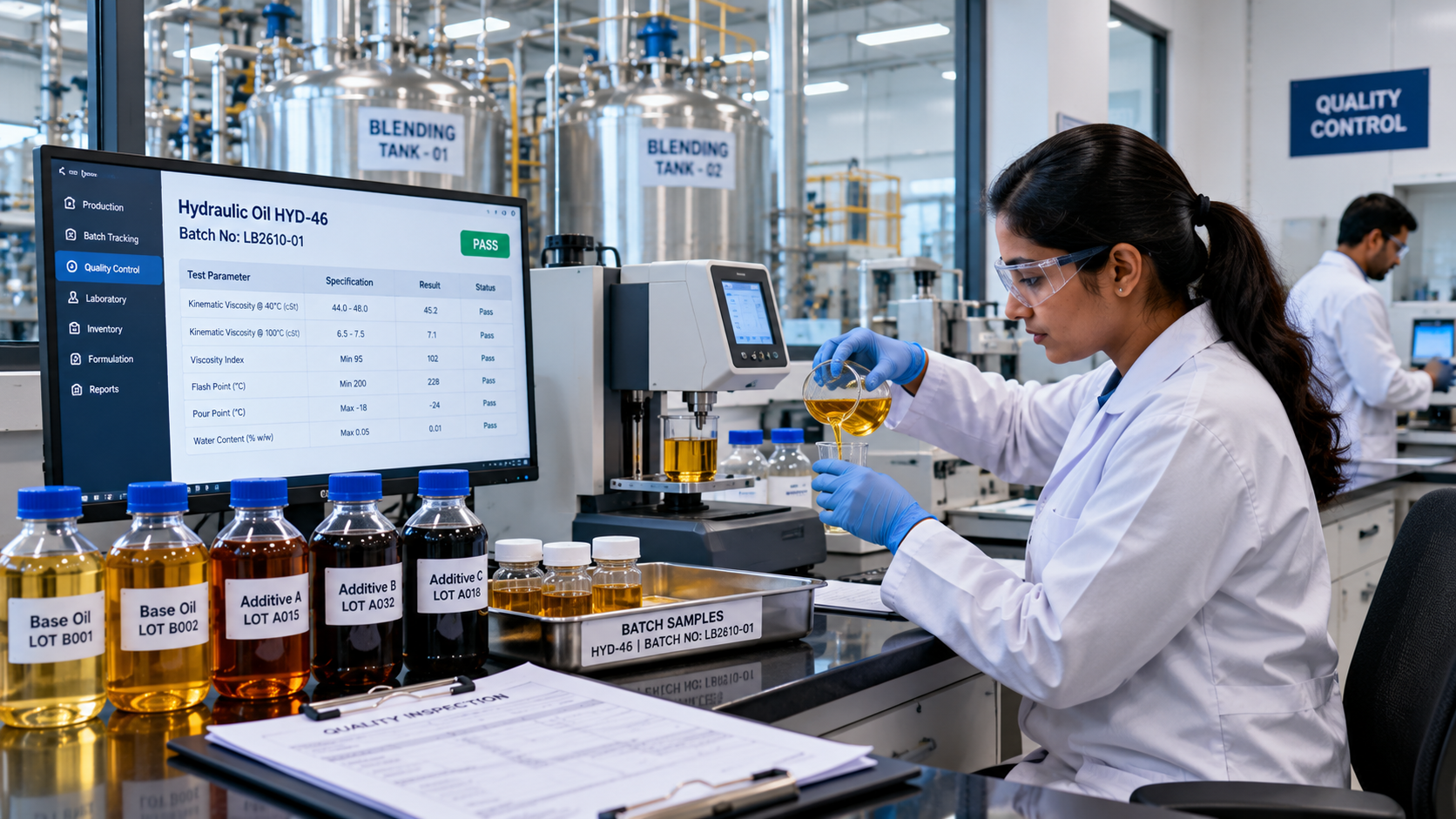
In lubricant manufacturing, every batch must meet an approved formulation and defined quality specifications. A minor variation in raw material quantity, blending conditions or product characteristics can affect performance and customer acceptance. GloudOne connects material dispensing, blending execution, laboratory inspection, quality decisions and batch traceability through one controlled production process.
The Business Challenge
A lubricant manufacturer releases a planned batch of industrial hydraulic oil for production. Base oils and additives are issued from different storage locations and raw material lots. Operators must follow the approved formulation, record actual quantities and maintain the required blending conditions. After blending, laboratory tests must confirm that the product meets specifications. If the batch fails inspection, management must decide whether to hold, correct, reprocess or reject it. Without reliable records, identifying the cause of a quality failure or tracing affected finished products becomes difficult.
How GloudOne Addresses It
GloudOne connects the approved batch plan with actual production activities, material consumption, quality verification and traceability records.
- Batch identification: Assign a unique production batch number linked to the product grade, approved formulation and production order.
- Raw material lot tracking: Record the source lots of base oils, additives and other materials consumed in each batch.
- Material dispensing control: Compare planned ingredient quantities with actual quantities issued and consumed.
- Blending execution: Record production start and completion, equipment used, operating parameters and process observations.
- In-process monitoring: Capture relevant production readings, deviations and operator observations during blending.
- Laboratory testing: Register samples and record test results against defined product specifications, such as viscosity and other applicable quality parameters.
- Quality approval workflow: Maintain batch status as pending inspection, approved, on hold, rejected or released according to authorised quality decisions.
- Rework and correction: Document approved corrective formulations, additional material consumption, retesting and associated costs.
- Batch genealogy: Trace raw material lots to production batches and subsequently to filling, packaging and finished goods records.
- Quality documentation: Maintain inspection reports, laboratory results, approvals and applicable certificates against the production batch.
Management Intelligence
Management can monitor batches under production, laboratory results pending approval, batches on quality hold, material consumption deviations, rework frequency, rejected quantities and quality-related costs. Traceability information supports investigations into product complaints, raw material issues and affected finished goods, helping management respond with greater accuracy and control.
Expected Business Outcomes
Stronger formulation compliance, improved batch consistency, more disciplined quality approvals, better visibility of material deviations and rework costs, faster investigation of quality issues and reliable traceability from raw material lots to finished products.
BUSINESS CASE 06 | BATCH / PROCESS MANUFACTURING
The Batch Is Approved. But How Much Finished Product Becomes Profit?
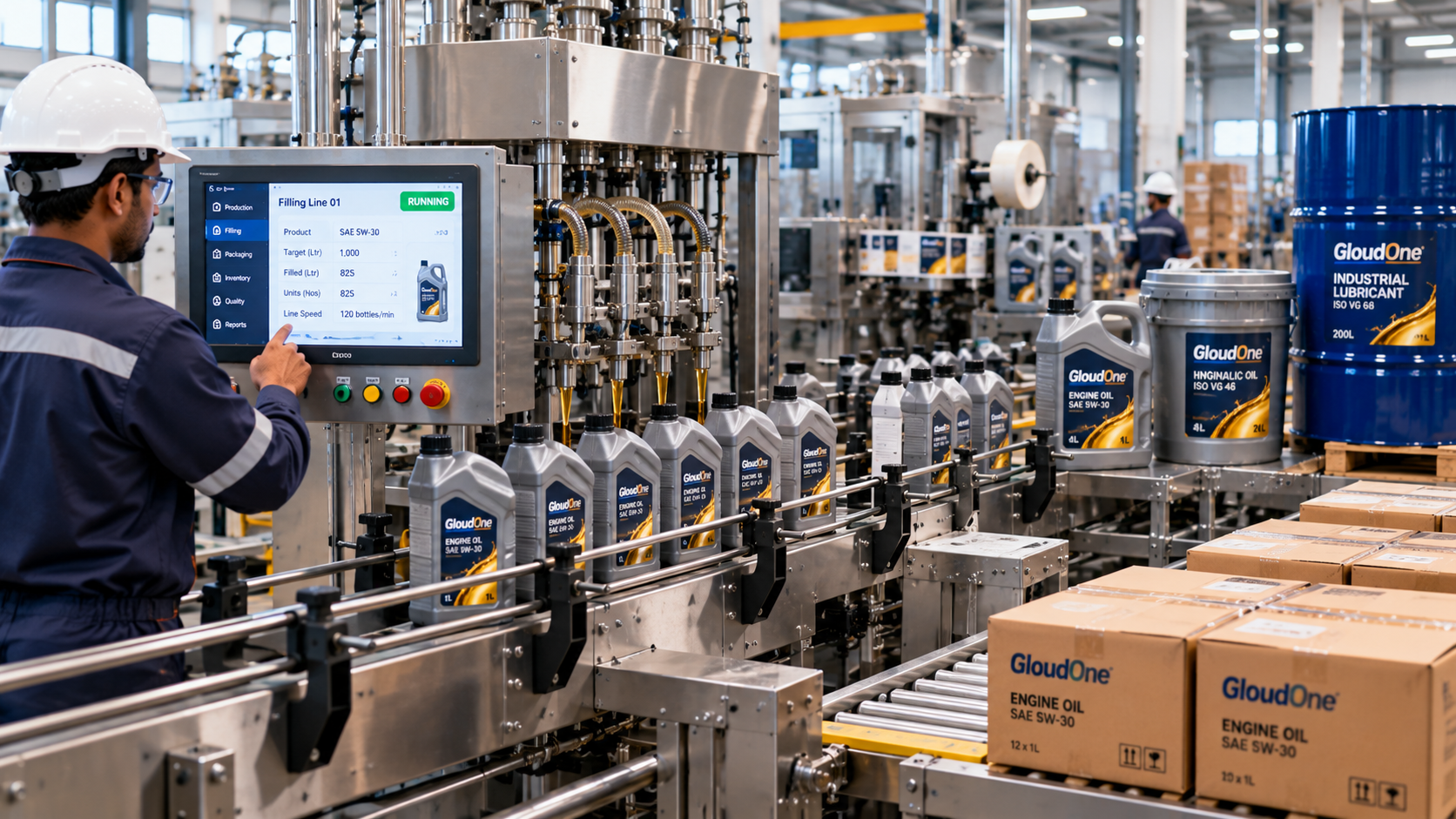
A successfully blended and quality-approved lubricant batch must still pass through filling, packaging, labelling and finished goods processing. Every litre lost, damaged container, incorrect filling quantity or additional packaging cost affects profitability. GloudOne connects approved bulk production with filling operations, packaging materials, finished goods, inventory valuation and actual batch profitability.
The Business Challenge
A lubricant manufacturer completes a batch of engine oil and receives quality approval. The same bulk product must be packed into 1-litre bottles, 4-litre containers, 20-litre pails and 200-litre drums according to customer requirements. Packaging materials must be available, filling lines must be scheduled and finished quantities must be reconciled against bulk material issued. Spillage, filling variations, rejected containers, damaged labels and unrecorded consumption can create differences between expected and actual yield. Management needs to know the true cost and margin of every finished product and packaging variant.
How GloudOne Addresses It
GloudOne connects the approved bulk batch with packaging orders, filling activities, material consumption, quality verification and finished goods costing.
- Approved bulk batch allocation: Release quality-approved lubricant quantities for filling and packaging while maintaining batch identification.
- Packaging variant planning: Allocate bulk product quantities across bottles, cans, pails, drums and other approved pack sizes.
- Packaging material requirements: Calculate containers, caps, labels, cartons, seals and other packaging materials required for planned production.
- Filling line scheduling: Plan filling operations according to equipment availability, production priorities and packaging requirements.
- Actual filling quantities: Record filled units, pack sizes, actual bulk consumption and completed quantities for each filling order.
- Production yield monitoring: Compare expected output with actual finished quantities and identify filling losses, residual quantities and approved process allowances.
- Packaging wastage and rejection: Capture damaged containers, rejected packs, incorrect labels, rework and additional packaging consumption.
- Finished goods identification: Maintain product grade, pack size, production batch, packaging details and applicable traceability references.
- Finished goods inventory: Transfer approved packed products into warehouse stock for order fulfilment, dispatch and inventory valuation.
- Actual batch and product costing: Consolidate blending costs, packaging consumption, filling expenses, wastage and other applicable production costs to determine finished product cost.
Management Intelligence
Management can monitor bulk quantities awaiting filling, planned versus actual packed output, filling line productivity, packaging material consumption, rejected units, yield losses and actual production costs. Profitability analysis can compare finished product costs and selling prices across grades, packaging sizes, production batches and customer orders, helping identify where manufacturing margins are being reduced.
Expected Business Outcomes
Improved filling efficiency, better control of packaging materials, reduced unrecorded production losses, stronger finished goods traceability, more accurate inventory valuation and clearer visibility of actual product costs and profitability.
BUSINESS CASE 07 | LINE / REPETITIVE MANUFACTURING
Production Targets Are Easy to Set. Making Every Line Ready Is the Real Challenge.
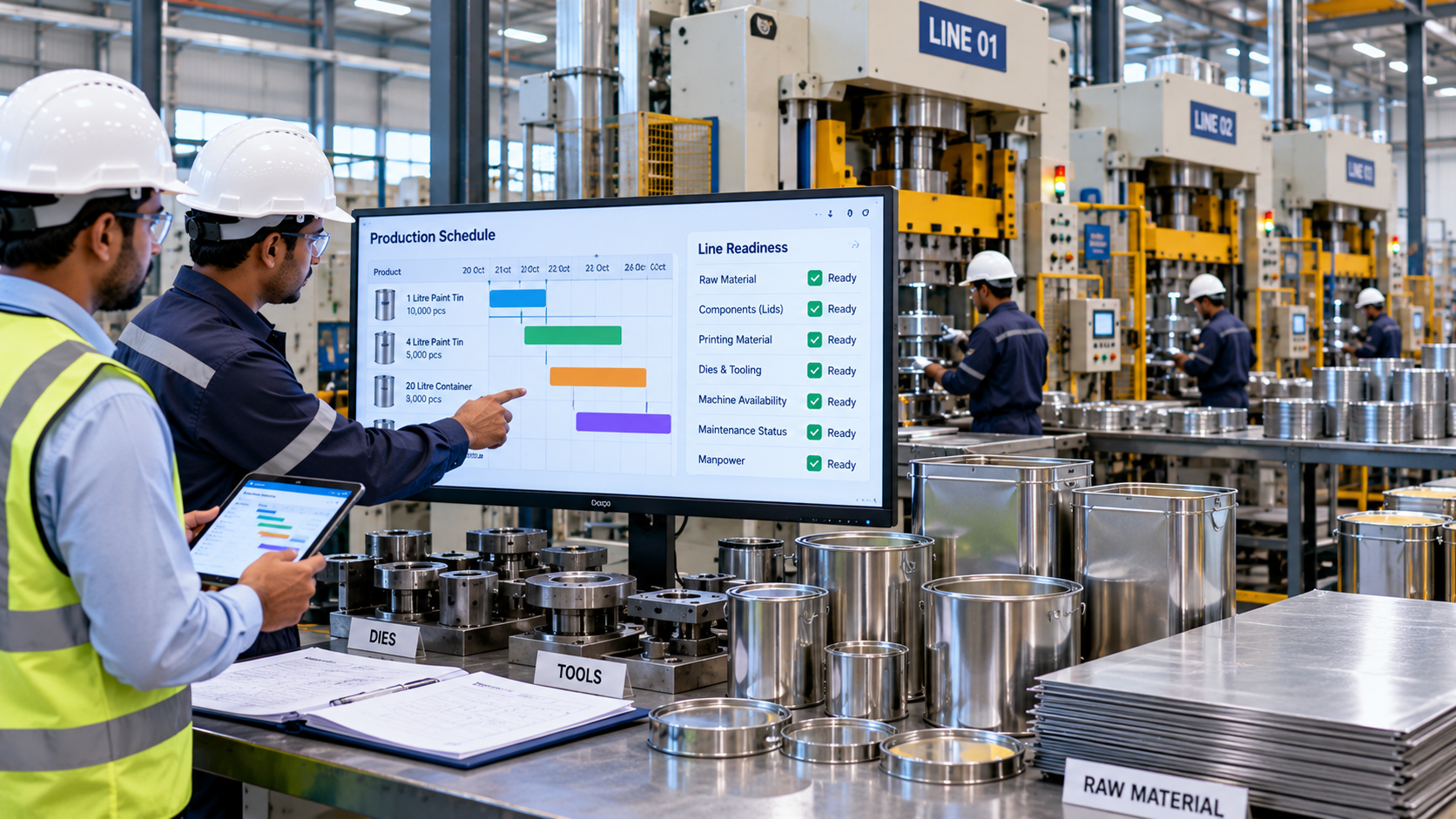
In repetitive manufacturing, production efficiency depends on continuous material availability, machine readiness, tooling, manpower and accurate scheduling. A missing die, delayed raw material or unexpected machine breakdown can disrupt an entire production line. GloudOne connects sales demand, material planning, production capacity, tooling readiness and shop-floor scheduling to help manufacturers prepare every production run with greater control.
The Business Challenge
A metal packaging manufacturer produces paint tins and industrial containers in different sizes. Customer orders require varying quantities, dimensions, metal sheet specifications, lids and printing requirements. Production involves sheet cutting, forming, seaming, printing and finishing operations. Each product may require specific dies, machine settings and production sequences. When schedules are prepared without confirming raw materials, machine capacity, tooling availability and maintenance status, production delays, frequent changeovers and unnecessary overtime can reduce profitability.
How GloudOne Addresses It
GloudOne brings customer demand, inventory, production resources and manufacturing schedules into a coordinated planning process.
- Demand and production planning: Consolidate customer orders, forecasts and stock replenishment requirements into planned production quantities.
- Product specifications and routing: Maintain product sizes, material specifications, approved components and required production operations.
- Material requirement planning: Calculate metal sheets, coatings, printing materials, lids, handles and other components needed for scheduled production.
- Inventory and procurement readiness: Compare material requirements with available stock, reservations and expected supplier deliveries.
- Machine capacity planning: Evaluate machine availability, production speeds, operating shifts and planned manufacturing capacity.
- Dies and tooling management: Identify the dies, moulds, fixtures and tools required for each product and confirm their availability and condition.
- Maintenance coordination: Consider planned maintenance, machine restrictions and unresolved equipment issues before releasing production schedules.
- Production sequencing: Arrange manufacturing runs to manage product changes, tooling changeovers, production priorities and delivery commitments.
- Manpower and shift planning: Assign production teams, supervisors and planned working shifts to scheduled manufacturing operations.
- Production order release: Authorise manufacturing only after the required materials, equipment, tooling and production instructions are ready.
Management Intelligence
Management can monitor production schedules, material shortages, machine loading, tooling availability, planned changeovers, maintenance conflicts, production orders awaiting release and delivery commitments at risk. This enables earlier intervention when capacity or resource constraints threaten production targets.
Expected Business Outcomes
Improved production readiness, fewer avoidable line stoppages, better utilisation of machines and tooling, reduced scheduling conflicts, more reliable customer delivery commitments and stronger coordination between sales, procurement, maintenance and production teams.
BUSINESS CASE 08 | LINE / REPETITIVE MANUFACTURING
A Running Machine Doesn’t Always Mean a Productive Factory.
In repetitive manufacturing, production performance depends on how efficiently every machine, production line and working shift converts materials into acceptable finished products. Unplanned stoppages, reduced machine speeds, material wastage and rejected output can significantly increase manufacturing costs. GloudOne connects production targets with actual shop-floor activities, helping management identify where productivity and profitability are being lost.

The Business Challenge
A metal container manufacturer schedules the production of thousands of paint tins across multiple machines and shifts. Although the production line operates throughout the day, actual output may fall below planned quantities because of machine breakdowns, die adjustments, material feeding problems, frequent changeovers and quality rejection. Production supervisors record output manually, while maintenance and quality teams maintain separate records. Without a consolidated view, management struggles to identify the actual causes of lost production time and increasing unit costs.
How GloudOne Addresses It
GloudOne connects production execution, machine utilisation, maintenance, quality inspection and manufacturing costs through a structured shop-floor reporting process.
- Shift-wise production targets: Define planned output by production line, machine, product and working shift.
- Actual production recording: Capture manufactured quantities, accepted units, rejected units and work-in-progress against production orders.
- Machine downtime monitoring: Record stoppage start and end times, downtime duration and reasons such as breakdowns, material shortages and tooling adjustments.
- Production speed monitoring: Compare expected machine output with actual production rates to identify reduced operating performance.
- Changeover tracking: Monitor time spent changing dies, tooling, product sizes and machine settings between production runs.
- Material consumption: Compare planned raw material requirements with actual usage, including scrap, offcuts and recoverable materials.
- Quality rejection and rework: Capture defective output, rejection reasons, corrective actions and additional processing costs.
- Maintenance coordination: Connect machine breakdown reports with maintenance requests, repair activities and equipment availability.
- Operator and shift performance: Compare production achievements across shifts, machines and teams using consistent performance measures.
- Production efficiency analysis: Evaluate availability, operating performance and quality to support appropriate overall equipment effectiveness (OEE) reporting.
Management Intelligence
Management can monitor planned versus actual production, machine-wise output, shift performance, downtime by reason, rejection percentages, scrap quantities, changeover losses and production efficiency. Where the required operating data is captured, OEE analysis helps distinguish losses caused by equipment availability, reduced operating speed and quality rejection. These insights support decisions on maintenance priorities, process improvements, manpower allocation and production cost control.
Expected Business Outcomes
Better visibility of shop-floor performance, faster identification of production bottlenecks, reduced avoidable downtime, improved machine utilisation, stronger control over scrap and rejection, more reliable production reporting and improved manufacturing cost efficiency.
BUSINESS CASE 09 | LINE / REPETITIVE MANUFACTURING
Production Is Not Complete Until Every Finished Product Is Accounted For.
Manufacturing success is not measured only by how much a factory produces. It also depends on how accurately finished products are inspected, accounted for, stored, dispatched and costed. GloudOne connects production completion with quality control, finished goods inventory, customer deliveries and financial performance, helping management understand not only what was manufactured, but also what it cost and how much value it generated.

The Business Challenge
A metal container manufacturer produces different sizes and specifications of paint tins for multiple customers. After manufacturing, finished containers undergo quality inspection, counting, packing, warehouse transfer and dispatch. Some products are manufactured against confirmed customer orders, while others are produced for stock. Rejected quantities, packing differences, unrecorded warehouse movements and delayed dispatches can create discrepancies between production reports and available inventory.
At the same time, actual manufacturing costs may differ from estimates because of raw material price variations, scrap, machine downtime, labour costs and production overheads. Without connecting these activities, management may know the total production quantity but not the true cost, available stock, order fulfilment position or profitability of individual products.
How GloudOne Addresses It
GloudOne brings together finished goods management, quality approval, warehouse operations, customer order fulfilment, production costing and financial reporting within one connected business process.
- Production completion: Record completed quantities against production orders, including accepted output, rejected quantities and pending work-in-progress.
- Finished goods quality inspection: Verify product dimensions, finishing, printing, packing requirements and customer-specific quality standards before stock release.
- Finished goods identification: Maintain product specifications, sizes, production references, batch or lot identification where applicable, and traceability information.
- Packing and labelling: Manage packing quantities, cartons, pallets, labels and customer-specific dispatch requirements.
- Warehouse stock transfer: Transfer approved finished products from production to designated warehouse locations with recorded quantities and movement references.
- Inventory visibility: Monitor available, reserved, quality-hold and dispatch-ready finished goods across products and storage locations.
- Customer order allocation: Match finished stock against sales orders, delivery schedules and customer commitments.
- Dispatch management: Coordinate picking, packing verification, delivery documentation and dispatch confirmation.
- Production cost accumulation: Consolidate raw material consumption, labour, machine-related costs and applicable manufacturing overheads against production orders.
- Variance analysis: Compare standard or estimated manufacturing costs with actual costs, including material consumption differences, scrap and production inefficiencies.
- Product profitability: Analyse manufacturing cost and sales realisation by product, customer order or production batch, subject to the configured costing method.
- Finance integration: Connect finished goods valuation, inventory movements, cost of goods sold and sales transactions with financial accounting.
Management Intelligence
Management gains a consolidated view of completed production, quality-approved quantities, rejected output, finished goods stock, pending customer orders, dispatch readiness and delivery performance. Manufacturing intelligence can highlight production cost per unit, material consumption variances, inventory valuation, stock ageing, product-wise margins and line-wise cost performance. These insights help management identify where production is creating value and where costs, delays or inventory inefficiencies are reducing profitability.
Expected Business Outcomes
Improved finished goods accuracy, stronger product traceability, better warehouse control, faster dispatch coordination, more reliable customer order fulfilment, improved manufacturing cost visibility and better-informed profitability decisions. From raw material consumption to finished goods delivery, management can evaluate manufacturing performance through connected operational and financial information.
GLOUDONE | MANUFACTURING
See How GloudOne Can Work for Your Manufacturing Business
Connect production planning, material requirements, procurement,
inventory, shop floor operations, quality control, costing,
finance and management intelligence through
one unified business platform.
inventory, shop floor operations, quality control, costing,
finance and management intelligence through
one unified business platform.