
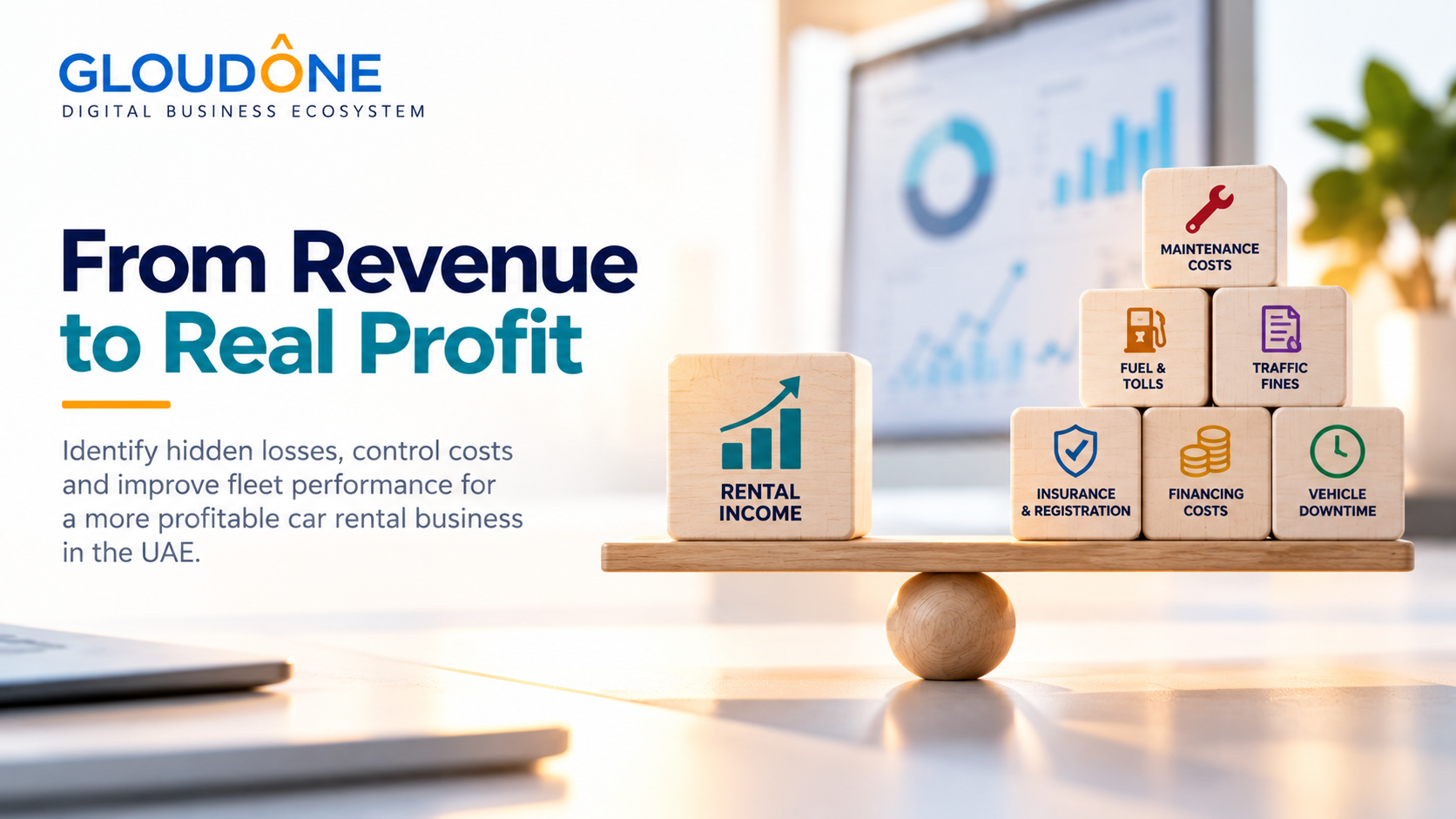
Car rental profitability UAE depends on controlling revenue leakage, vehicle downtime, operating costs and customer collections.
A vehicle can be rented every day and still fail to deliver the profit your business expects.
For car rental and leasing companies in the UAE, business performance cannot be measured by rental agreements and fleet utilisation alone. True profitability depends on how effectively the company manages vehicle availability, rental income, financing, maintenance, customer collections and operating expenses.
A busy fleet may generate substantial revenue while hidden operational gaps gradually reduce the company’s financial returns. Understanding where these losses originate is the first step towards building a more profitable rental business.
1. Revenue Leakage: The Hidden Cost of Rental Operations
Revenue leakage occurs when a rental business fails to collect income it has earned or incurs avoidable costs because operational activities are not properly controlled.
Consider a few common situations:
- A customer extends a rental agreement, but the additional rental period is not billed promptly.
- A vehicle is returned with excess kilometres, but the additional charge is missed.
- Salik toll charges and traffic fines are received after the rental agreement is closed, without an effective recovery process.
- Vehicle damage is recorded during collection, but the related recovery is not followed through.
- Discounts are approved informally without sufficient management visibility.
Individually, these transactions may appear small. Across hundreds of vehicles and thousands of rental agreements, their cumulative impact can become significant.
The objective should not simply be faster billing. It should be ensuring that every recoverable charge is identified, accounted for and followed through.
2. Car Rental Profitability UAE: How Vehicle Downtime Reduces Earnings
Every rental vehicle represents an investment. Whether purchased outright, financed through a bank or acquired under another financing arrangement, a vehicle continues to generate costs even when it is not earning rental income.
Insurance, depreciation, financing obligations and other ownership costs do not disappear when the vehicle is unavailable.
A vehicle may remain idle because of delayed maintenance, accident repairs, incomplete documentation, branch-level coordination issues or slow decisions about its next rental.
Rental companies should understand:
- How many days each vehicle is available for rental.
- How many days it is actually rented.
- How long it remains under maintenance or repair.
- Why it is unavailable.
- What revenue opportunity may have been lost during avoidable downtime.
A connected operational system can help management distinguish necessary downtime from delays that could have been prevented.
3. Collections and Security Deposits: Protecting Cash Flow
A profitable rental agreement does not automatically produce healthy cash flow.
Rental businesses often deal with advance payments, recurring lease invoices, overdue customer balances, security deposits, post-rental charges and refunds.
When collections are disconnected from rental operations, management may struggle to identify customers whose agreements remain active despite overdue payments.
Security deposits introduce another layer of responsibility. At vehicle return, the company may need to consider outstanding rental charges, traffic fines, Salik transactions, vehicle damage and applicable refund waiting periods.
For official information on toll charges in Dubai,
visit the
Salik official website
.
A structured process should connect these transactions with the original customer and rental agreement. This improves financial accountability while helping companies avoid unnecessary refund disputes and missed recoveries.
4. Vehicle-Level Profitability: Revenue Is Only Half the Picture
Fleet profitability cannot be evaluated accurately through rental income alone. Two vehicles may generate similar monthly rental revenue but deliver very different financial results.
One vehicle may have lower financing costs, fewer repairs and stronger utilisation. Another may carry higher instalments, frequent maintenance expenses and repeated downtime.
Meaningful profitability analysis should consider:
- Rental and leasing revenue.
- Financing interest and related charges.
- Depreciation.
- Insurance and registration.
- Maintenance and accident-related expenses.
- Other directly attributable operating costs.
- Vehicle utilisation and downtime.
Management should also distinguish cash-flow commitments, such as loan principal repayments, from accounting expenses when calculating profit.
With connected operational and financial information, companies can identify vehicles that contribute strongly to profitability and those that require corrective action.
5. Why Fleet Utilisation Alone Can Be Misleading
Fleet utilisation is an important performance indicator, but it should never be viewed in isolation.
A vehicle rented at an excessively discounted rate may show excellent utilisation without generating an acceptable return. Similarly, a long-term lease may provide predictable revenue while producing limited margins after financing and maintenance costs.
Management needs to evaluate utilisation alongside rental yield, operating costs, collections and profitability.
Are we renting more vehicles, or are we earning more from our fleet?
The distinction matters when deciding whether to increase fleet size, revise rental pricing, renew a lease arrangement or dispose of an underperforming vehicle.
6. Management Intelligence: Identify Problems Before They Become Losses
Traditional rental reporting often concentrates on completed transactions. Management reviews the number of agreements created, vehicles rented, invoices issued and payments received.
While useful, these reports may not highlight emerging operational risks.
A more connected approach can help management identify vehicles approaching maintenance requirements, overdue customer collections, repeated discounts, extended downtime and unusual cost patterns.
The objective is to move from simply recording business activity towards identifying situations that require management attention.
For example, a vehicle repeatedly entering the workshop should be reviewed not only for maintenance expenditure but also for its lost rental opportunities and overall financial contribution.
7. How GloudOne Connects Rental Operations and Financial Performance
GloudOne is designed as an integrated digital business management platform that connects operational activities with finance, workflows and management information.
For car rental and leasing companies, this approach brings together rental agreements, fleet movements, vehicle delivery and collection, customer records, billing, receivables, maintenance and financial reporting.
Rather than treating these as isolated activities, GloudOne helps businesses maintain connected information across the vehicle lifecycle.
This provides a foundation for stronger operational accountability, more consistent financial controls and better management visibility.
Explore our
Car Rental Software UAE
solution to understand how GloudOne supports rental and leasing operations.
You can also read
Car Rental Software UAE: Beyond Fleet Management
to understand why fleet operations and financial management should work together.
8. Building a More Profitable Car Rental Business
Improving car rental profitability does not always require purchasing more vehicles or increasing rental prices. Often, the opportunity lies in managing existing assets more effectively.
Reducing missed charges, controlling unnecessary downtime, improving collections, monitoring vehicle costs and identifying underperforming assets can strengthen business performance.
For UAE rental and leasing companies, the long-term objective should be to connect every important operational event with its financial impact.
Protect every earning opportunity. Control every vehicle investment. Make every management decision count.
GLOUDONE | CAR RENTAL & LEASING
Turn Better Fleet Control into Better Business Performance
Connect rental operations, vehicle costs, billing, collections and management intelligence with GloudOne.